As private equity firms and strategic acquirers look ahead to 2026, the restaurant franchise sector continues to stand out as one of the most compelling platforms for scalable growth, capital efficiency, and disciplined value creation. After several years of operational volatility, cost inflation, and capital market recalibration, the franchise model is reasserting its structural advantages, particularly for investors seeking predictable cash flows, expansion optionality, and professionalized governance.
While challenges remain, the overall outlook for restaurant franchising in 2026 is decisively positive. For well-capitalized sponsors and experienced M&A operators, the coming cycle presents a window to consolidate, optimize, and scale high-quality franchise systems with greater clarity than at any point since the pre-pandemic era.
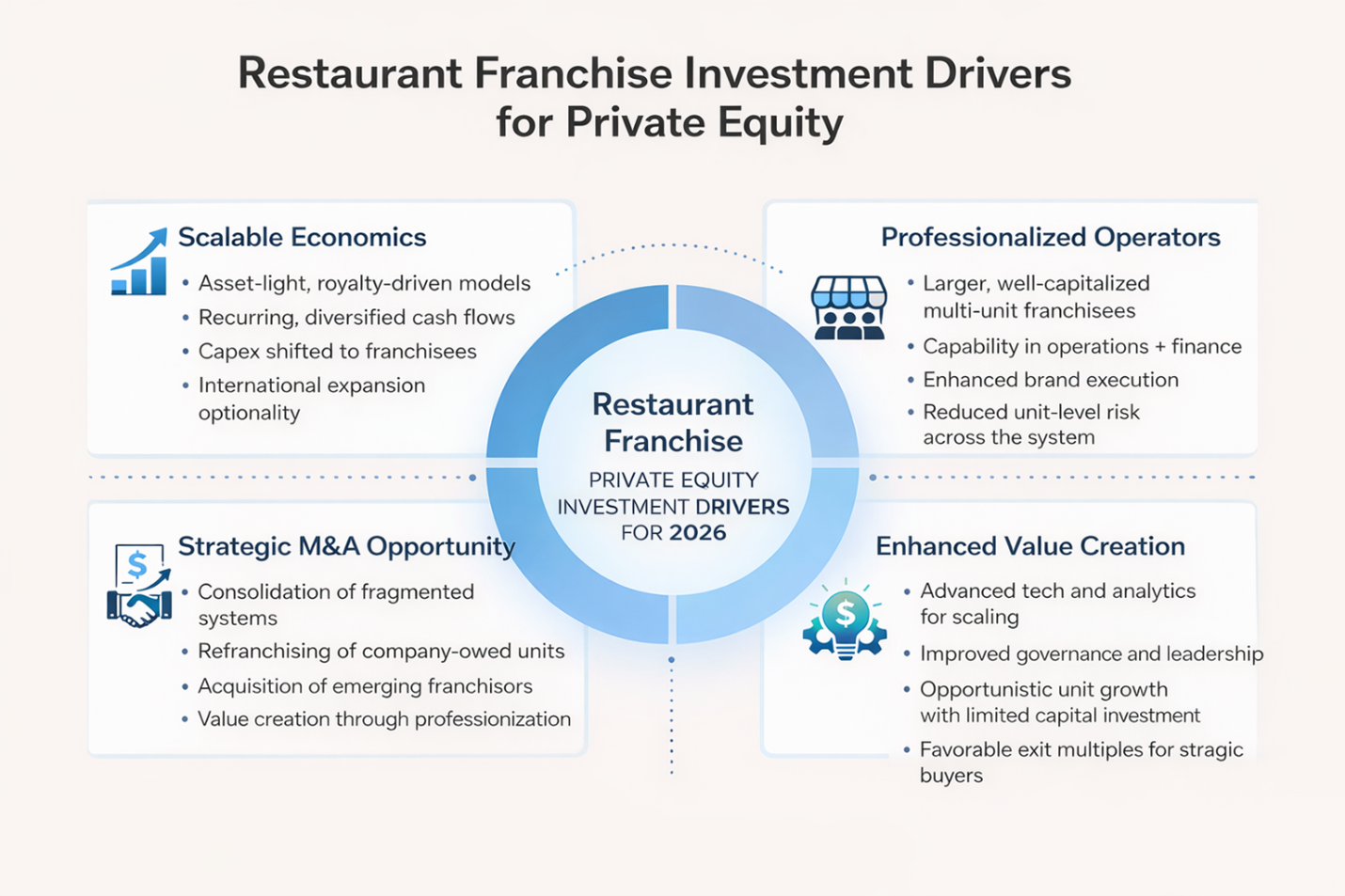
Why the Franchise Model Is Re-Emerging as a PE Favorite
At its core, the franchise restaurant model aligns cleanly with private equity investment principles. Asset-light economics, diversified unit-level risk, recurring royalty streams, and scalable infrastructure create an attractive foundation for both growth and margin resilience.
Heading into 2026, these advantages are becoming even more pronounced. Labor volatility and real estate costs continue to pressure company-owned models, while franchised systems shift a significant portion of operational risk to local operators. This dynamic not only stabilizes cash flow at the franchisor level but also enhances visibility for lenders and equity partners evaluating long-term returns.
Additionally, franchise systems benefit from embedded growth mechanisms. Unit expansion, refranchising initiatives, territory development agreements, and international licensing provide multiple levers for value creation without proportional increases in corporate overhead.
For private equity firms seeking scalable platforms rather than one-off unit economics, franchising offers a uniquely efficient path forward.
Improved Unit Economics and Operator Sophistication
One of the most encouraging signals entering 2026 is the increasing sophistication of franchise operators themselves. Multi-unit franchisees are larger, better capitalized, and more operationally disciplined than in prior cycles. Many now operate portfolios that resemble small private companies, complete with regional management structures, professional finance teams, and data-driven decision-making.
This evolution materially strengthens the franchise ecosystem. Stronger operators mean more consistent brand execution, improved unit-level economics, and greater resilience during periods of macroeconomic uncertainty. For PE investors, this reduces systemic risk across the franchise base and increases confidence in forward growth assumptions.
At the same time, brands that have invested in training, technology, and franchisee support infrastructure are seeing higher-quality development partners gravitate toward their systems, creating a virtuous cycle of performance and expansion.
M&A Activity: From Opportunistic to Strategic
Restaurant franchise M&A heading into 2026 is becoming more disciplined and strategic. Rather than chasing distressed assets or short-term rollups, acquirers are increasingly focused on platforms with durable brand equity, clean unit economics, and leadership teams capable of scaling.
Key M&A drivers include:
Consolidation within fragmented franchise systems.
Acquisition of emerging franchisors with proven unit economics.
Refranchising of company-owned units to accelerate capital-light growth.
Add-on acquisitions that expand geographic reach or daypart relevance.
Importantly, valuation expectations between buyers and sellers have become more aligned. After a period of pricing dislocation, the market is settling into a more rational equilibrium, one that rewards operational excellence, governance maturity, and leadership depth rather than speculative growth narratives.
This environment favors experienced private equity sponsors who can underwrite complexity, support executive leadership, and drive professionalization post-acquisition.
Technology, Data, and Franchise Scalability
Another tailwind for the franchise restaurant space in 2026 is the maturation of technology platforms that support scalability. Franchise systems now have access to advanced tools for unit-level reporting, labor optimization, supply chain management, marketing attribution, and customer engagement.
For investors, this improves transparency and control across geographically dispersed portfolios. For franchisors, it strengthens the value proposition to franchisees by enabling better decision-making and more consistent execution.
Crucially, technology adoption is also reshaping governance. Brands that can standardize data, enforce accountability, and measure performance objectively are better positioned to scale responsibly, an increasingly important consideration for PE firms evaluating platform longevity.
Leadership and Governance as Value Multipliers
As franchise systems scale, leadership quality becomes the primary determinant of outcomes. The most attractive franchise investments heading into 2026 share a common trait: executive teams capable of managing complexity across franchisee relations, operations, finance, and brand stewardship.
Private equity firms are placing greater emphasis on governance structures, executive depth, and succession planning as part of the investment thesis. Strong CEOs, CFOs, and franchise-focused operators not only reduce execution risk but also accelerate value creation by aligning stakeholders and professionalizing systems.
In this context, leadership readiness is no longer a post-close consideration, it is central to underwriting and long-term return potential.
A Constructive Outlook for 2026
Despite lingering macro uncertainty, the restaurant franchise sector enters 2026 from a position of renewed strength. Brands are more disciplined, franchisees are more capable, technology is more enabling, and capital markets are more rational.
For private equity and M&A firms, this creates a favorable environment to:
Acquire scalable franchise platforms.
Drive operational and governance improvements.
Support disciplined unit expansion.
Position assets for durable exit multiples.
The opportunity is not in chasing growth for growth’s sake, but in backing franchise systems that combine strong unit economics, capable leadership, and infrastructure built to scale.
Franchising as a Durable PE Growth Engine
The restaurant franchise model is not merely surviving, it is evolving. Heading into 2026, it represents one of the most compelling intersections of operational leverage, capital efficiency, and scalable growth available to private equity investors and strategic acquirers.
Those who approach the space with discipline, long-term orientation, and a focus on leadership and systems will find that franchising offers not just stability, but meaningful upside in the next phase of restaurant industry consolidation and expansion.