A Circular Loop?
October Has Turned Out to be Silly Season Again
Restaurants were sucked into October Silly Season by confirmed news Thursday by David Faber at CNBC (the absolute best M&A reporter!) that Starbucks was conferring with investment bankers on purchasing Chipotle. That would have been stunning if completed as there would have been complexities to that deal.[1] By Monday morning, Starbucks officially denied they were purchasing Chipotle.
Circular Loop for Restaurants?
Restaurants are working very hard (in most cases) to offset the negative outside factors. But we stumble on many situations and outcomes that we can control. This note documents some of those factors. The good news is we can break out of the box we are in and break the circular loop. We have before.
Current Sales and Brand Leaders and Laggards Mostly Unchanged
In assessing current sales conditions my two best trackers have somewhat different views. The B of A sample saw SSS improvement on a one-year basis and positive SSS but trend lower on a two-year basis while my other tracker saw softness in both. B of A noted chains were at plus zero in September, while independents were up 5%. This continues share gain at independents, which has been evident for some time. Casual dining remained at a strong point in the first week of October and QSR was weak. We need more than a 2% SSS business to offset food, labor and commodity cost inflation.
In my view, we can’t change any of the macros, but control and improve what we can control.[2] In my opinion, what we can agree that too many restaurants are something under our control; we note better Board decisions are needed avoid the under-qualified and executives that have not been a fit. [3] And we must get the price/value/innovation/margin complex equation solved with brand specific models.
We are in a downturn, but the restaurant industry is cyclical. Cycles end. We should think about the positives, too. For one, restaurant sales and traffic have not collapsed as in 2008 or even 2020. There is interest and spending despite ever present economic columnist negative opinion. People need food options and restaurants do fulfill both that need and socialization venues at other times of day. On the main stage, look at Dave’s Hot Chicken and Jersey Mike’s are in the top 2-year sales gainer group already. New and well-built can work.
Restaurant Level Margins
With years of dual food and labor cost pressures since 2019 (especially 2022-2023), utility cost and CAPEX expense inflation, current inability to take much price, both company and franchisee unit margins are down. Franchisees less so (because they live on margins)[4] -–and that is a complicated story. The brands that are intense on discounting[5] or massive rebuilding (Starbucks as example) have picked up labor and CAPEX outlays and must generate a boatload of new profitable sales. Some of the powerful new brands are in great shape—20%. Starbucks in China fell to very low teens and believe that is where Starbucks US is now. [6] The now declining QSR brands—Wendy’s, the CKE restaurant group brands, and Papa John’s are in the lower double and single digits. [7] This is not workable going forward.
Of course, this is an EBITDA number typically and does not cover taxes, debt service or CAPEX unless it is high enough. This is why restaurants get run down and go bankrupt.
Company Chaos: CEO Turnover (s) and The Board
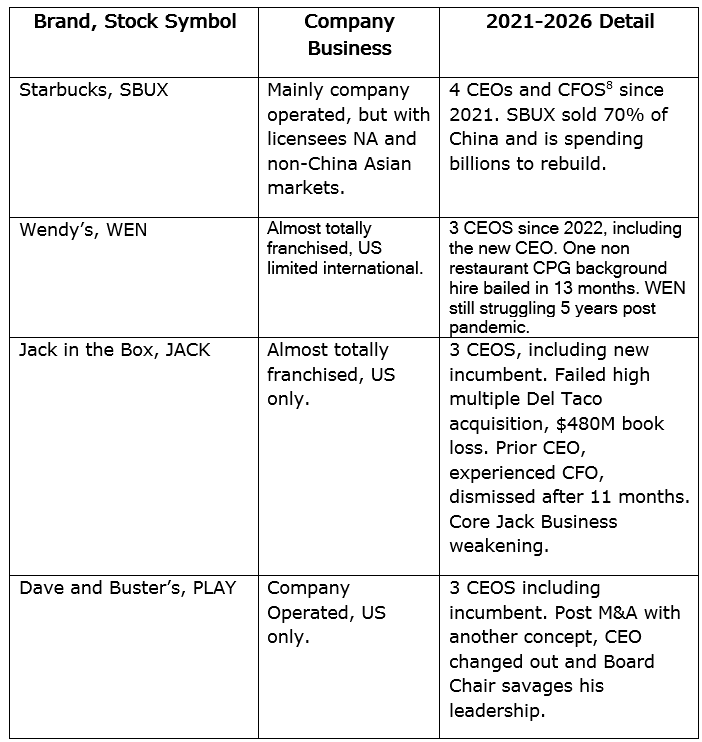
I’ve been thinking about[8] the organizational results for chain restaurants where there has been CEO or multiple CEO turnover over a short period of time, along with bad brand, financial and stakeholder results. Since 2020, all the following hit the list:
Challenging Restaurant CEO Turnover 2021-2026
In fairness to Boards, last week the Wall Street Journal published a good article, “What Boards Aren’t Told” on October 5. It details the usual control and lack of information machinations. We will analyze more.
=================
Below, please see restaurant organization consultant Mac Brand’s comments on Boards in the below short read, from at www.macbrandbooks.com:
Board members are often selected based on their resume, their connections, and/or the strength of their personal brand. Certainly, big names can attract investors, at least at first. Collaboration skills, understanding the organizational culture, and the team matter more.
Pouring over financial reports, competitive analysis, and ROI on Capex are all crucial functions. Yet, these tasks are NOT the differentiators of effective, successful boards. The most effective boards (and board members) focus on two things. First, they focus on effective collaboration with their fellow board members, versus winning every debate or being “right.” The focus is on making the right moves for this year and beyond, by leveraging the collective insights of the entire board.
Second, they all recognize that a business's most important competitive advantage is its people...
This means board members must understand and influence the organizational culture and how their firm compares in strategic vision and performance, among other things. Including the performance of the CEO…. There’s no substitute for being on the ground and in the moment.
==============
About the author: John A. Gordon MAFF is a long-time restaurant veteran and expert. Read about his insights here at Wray Search Insights also via his website, www.pacificmanagementconsultinggroup.com.
[1] Perhaps it was investment bankers just on a business development visit.
[2] See Darden CEO Rick Cardenas, September 2026 earnings call.
[3] The Starbucks CEO Laxman Narashimhan short tenure and termination is an example.
[4] The margin issue is intense in McDonald’s for example, where have a whole system to snoot for proper value
[5] Again, McDonalds but also others.
[6] Multiple US Security Analysts.
[7] Franchisors do not publish franchisee store level margins—other than QSR Brands and Dominos. QSR, DPZ.
[8] For sake of brevity, I’ve left out Papa John’s which went through 3 CEOs and is still negatively impacted by the broad pizza segment collapse (excluding Dominos).
[9] SBUX has had some very good CFOs. But they head out, which is a signal itself.