The State of Franchise Leadership Compensation
Compensation across franchise leadership roles continues to reflect the increasing complexity of the industry.
Multi-unit scale, franchisee relationships, development pipelines, and margin pressure have fundamentally changed what leadership requires—and compensation is rising accordingly.
To better understand how organizations are structuring pay Wray Executive Search surveyed franchise leaders across the United States, spanning Franchise Operations and Franchise Development roles at the Director, VP, and SVP levels.
The data reveals a clear pattern:
Compensation is strong at the top
Incentive structures play a meaningful role
Equity is increasingly part of total compensation
And despite competitive pay, retention risk is rising
Franchise Operations Salary Benchmarks
Franchise operations leaders are responsible for execution at scale—ensuring consistency, profitability, and franchisee success across locations.
Compensation reflects that responsibility:
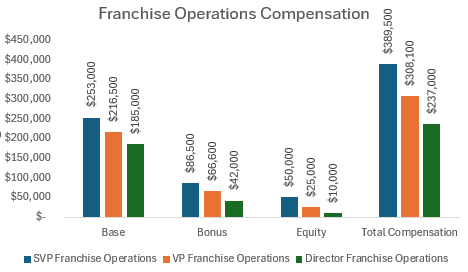
SVP Franchise Operations: $389,500 total compensation
VP Franchise Operations: $308,100 total compensation
Director Franchise Operations: $237,000 total compensation
A few important takeaways:
Bonus structures are significant, especially at the SVP level, where incentives exceeded $85,000 in 2025.
Equity is present but varies widely, often tied to company size or ownership structure
The step-up from Director to VP is substantial, reinforcing the importance of multi-unit leadership experience
Operations roles demand a balance of execution and leadership. Compensation aligns with that expectation, but it is not always enough to retain top performers.
Franchise Development Salary Benchmarks
Franchise development leaders sit at the center of expansion strategy.
From territory growth to franchisee recruitment, these roles directly influence revenue trajectory, which is reflected in compensation.
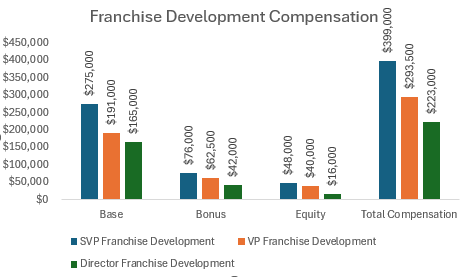
SVP Franchise Development: $399,000 total compensation
VP Franchise Development: $293,500 total compensation
Director Franchise Development: $223,000 total compensation
Key insights:
Development roles slightly outpace operations at the senior level, signaling the premium placed on growth
Equity participation is more prominent, especially for VP-level roles
Bonus structures remain strong, often tied to unit growth and deal flow
Organizations are clearly willing to pay for leaders who can scale—but demand for those leaders continues to outpace supply.
VP Franchise Operations Salary and Compensation Trends
One of the most important findings from the data is not the compensation itself—it’s how leaders feel about it.
When asked about the likelihood of seeking a new role due to compensation:
27% said very high
23% said high
That means 50% of franchise leaders are actively or seriously considering a move due to compensation concerns.
Even more telling:
Only 18% reported very low likelihood of leaving
This signals a critical shift. Compensation is no longer just a benchmarking exercise. It is directly tied to retention risk—and increasingly, to leadership stability.
Why Franchise Leaders Are Leaving
Compensation is only part of the story.
When leaders were asked why they are considering new roles, the responses revealed a broader set of drivers:
Desire for new challenges (32%)
Lack of career growth (27%)
Better compensation (27%)
Stronger leadership role (27%)
Better benefits (14%)
Cultural misalignment (14%)
Work-life balance and flexibility (9%)
Relocation (5%)
What stands out is the combination of financial and non-financial motivators.
Leaders are not just chasing higher pay. They are evaluating:
Long-term career trajectory
Organizational culture
Leadership alignment
Scope and impact of their role
These findings aligns closely with what we are seeing across the broader restaurant and hospitality industry—where leadership expectations are evolving faster than many organizations can keep up with
What This Means for Franchise Organizations
The implications are significant.
1. Compensation Must Be Competitive, But It Is Not the Differentiator
Organizations that rely solely on salary increases to retain talent will continue to face turnover.
Top leaders expect:
Clear growth paths
Strategic influence
Strong executive leadership
Alignment with brand vision
2. The Talent Market Is Tighter Than It Appears
Half of the leadership population considering a move creates a paradox:
High demand for talent
Limited supply of truly qualified leaders
This reinforces the importance of proactive franchise executive search, not reactive hiring.
3. Retention and Succession Planning Are Now Interconnected
As highlighted in Wray’s broader industry research:
Many organizations lack strong internal benches
Leadership transitions are accelerating
Development programs remain inconsistent
When compensation dissatisfaction is layered on top of weak succession planning, the result is:
Increased turnover risk
Longer search cycles
Higher cost of hiring mistakes
The Opportunity: Getting Ahead of the Market
The organizations that win in today’s environment are not the ones reacting to turnover.
They are:
Benchmarking compensation proactively
Building leadership pipelines early
Understanding what motivates their executives beyond pay
Partnering with specialists who understand franchise leadership dynamics
Franchise leadership is not interchangeable with broader “hospitality” or “consumer” roles.
The complexity is different.
The stakes are higher.
And the margin for error is smaller.
How Wray Executive Search Helps
At Wray Executive Search, we work exclusively within restaurant, franchise, and food-service leadership.
We understand:
What top franchise leaders expect
How compensation structures vary by role and growth stage
Where the best talent is, and what it takes to attract and activate them
More importantly, we help organizations:
Benchmark against the real market
Identify retention risks early
Build leadership teams that can scale
Final Thought
Compensation data tells an important story.
But the real insight is what sits beneath it:
Franchise leaders are evaluating more than what they earn.
They are evaluating where they can grow.
Organizations that recognize that shift—and act on it—will be the ones that build leadership teams capable of driving long-term success.